
Wood Science 101
Wood anatomy, moisture, dimensional stability, modification and decay — the science behind every wood building product, taught in plain language.
Presented to the Building Industry Association of Hawaii · 2025
- Level
- Introductory
- Length
- 60 minutes
- Who it’s for
- Architects, builders, dealers and specifiers
- Format
- In person or webinar
What you’ll learn
- Identify the three planes of wood — transverse, tangential and radial — and explain how a board’s position in the log determines its figure and its movement.
- Distinguish the tracheids that carry water in softwoods from the vessels only hardwoods build, and name the layers of the cell wall those cells are made of.
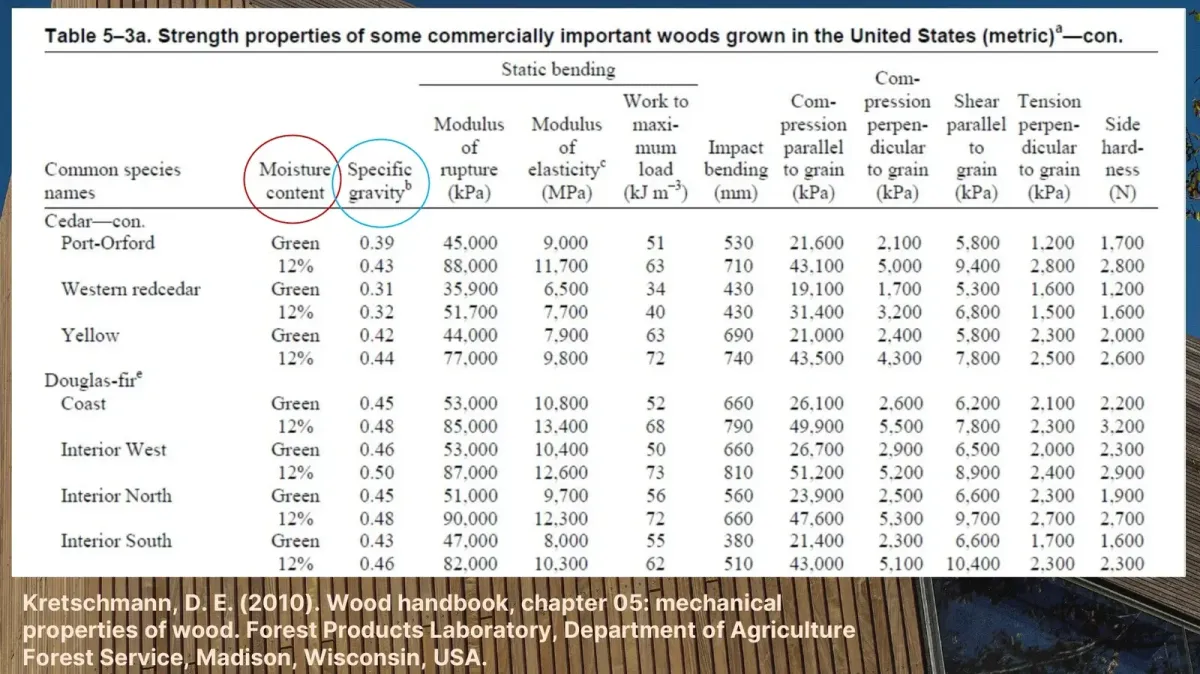
- Define density, specific gravity, modulus of elasticity (MOE) and modulus of rupture (MOR), and read them off a species data table.
- Calculate moisture content, and choose correctly between a pin and a capacitance meter in the field.
- Explain equilibrium moisture content and use it to set an acclimation target for a specific climate.
- Describe the fiber saturation point and predict when wood will and will not move dimensionally.
- Compare thermal, acetylation and dual modification, and state what each one changes in the cell wall.
- Diagnose the common agents of wood deterioration — UV, moisture, brown rot, white rot, staining fungi, termites and borers.
Every problem you will ever have with a wood building product — the cupped deck board, the split siding, the corroded screw, the rot at the base of a post — traces back to a handful of facts about how wood is built and how it handles water. Learn those facts and most "wood is unpredictable" complaints stop being mysterious. Wood is extremely predictable. It just does not behave like steel or concrete.
This is the written version of Wood Science 101, the course we teach to architects, builders and dealers. It covers wood anatomy, the physical and mechanical properties that show up in a span table, the relationship between wood and water, what modification actually changes, and how wood deteriorates.
1. Wood anatomy: the three planes
A log is not a homogeneous block. It is a bundle of long, hollow cells running up the stem, wrapped in annual growth rings, and tied together radially by rays. Because of that structure, the same piece of wood looks — and behaves — differently depending on which direction you cut it.
The easiest way to hold this in your head is a pie. The top of the pie is the cross section. The crust around the rim is the tangential face. A slice cut in toward the center exposes the radial face.
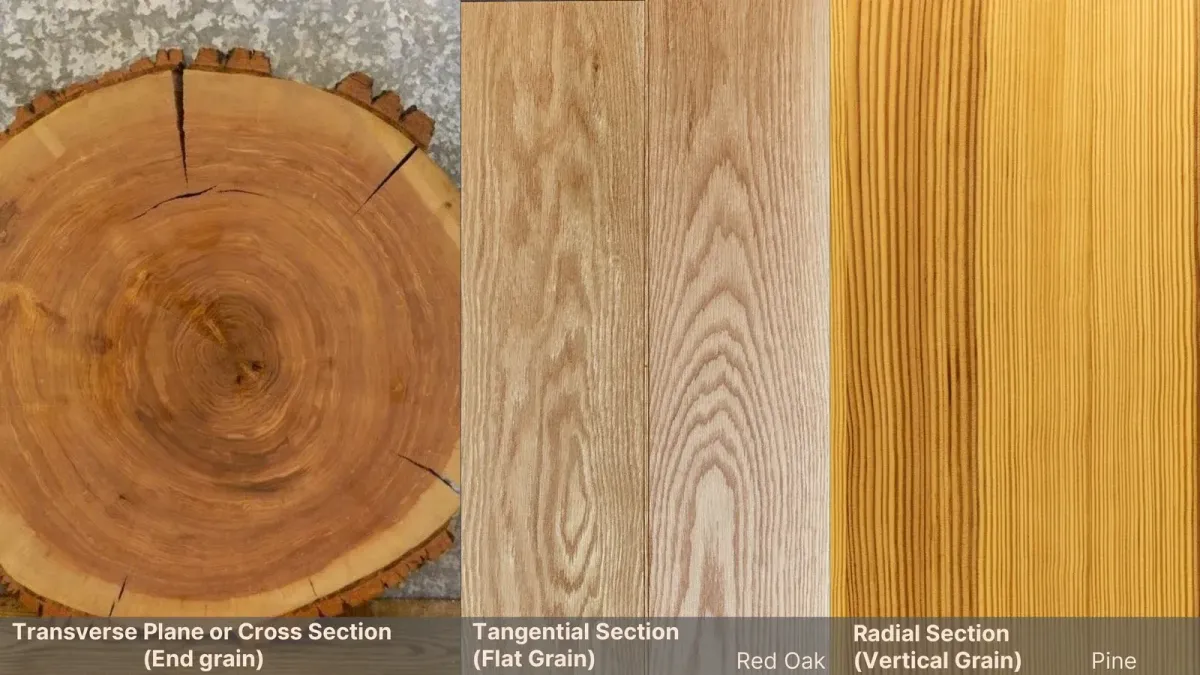
- Transverse plane (end grain). The face you see when you cut across the log. Growth rings, the pith at the center, rays radiating outward, heartwood in the middle and lighter sapwood toward the bark.
- Tangential plane (flat grain). Cut parallel — tangent — to the growth rings. This is the cathedral or "flame" figure most people picture when they picture wood.
- Radial plane (vertical grain). Cut perpendicular to the growth rings, on a radius. Straight, tight, parallel grain. Also called quartersawn.
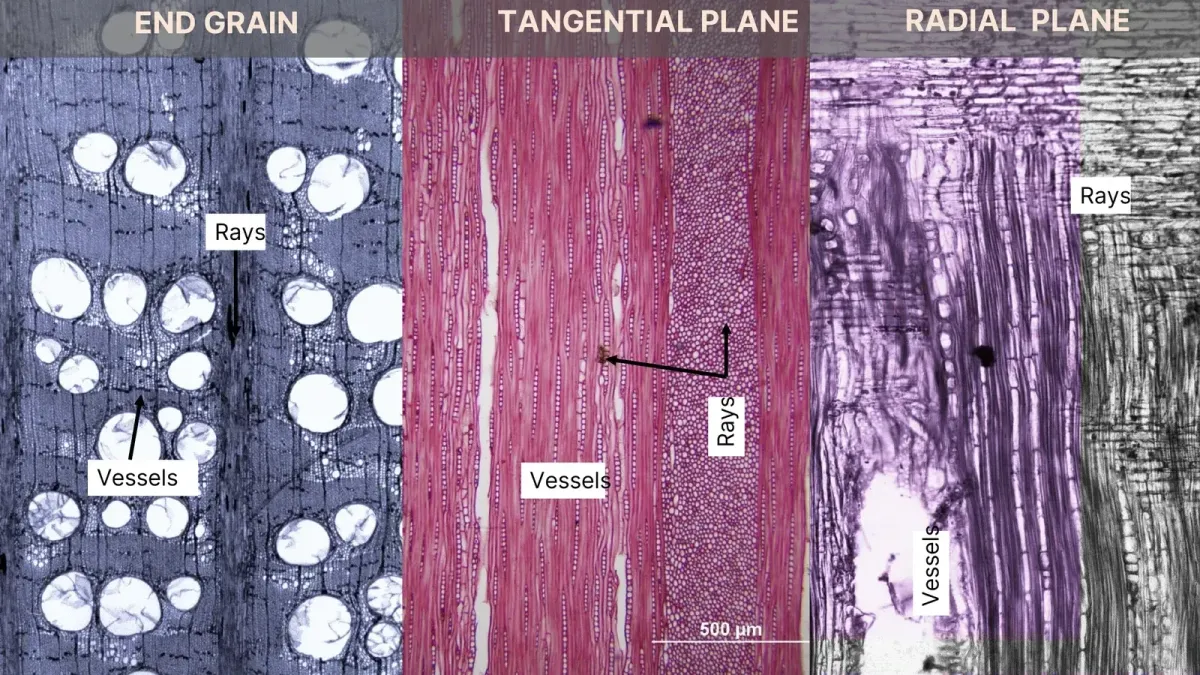
Under magnification you can see what makes each face different. Two features do most of the work: the vertical plumbing that carried sap up the tree, and the rays — ribbons of cells running horizontally from the pith outward, which show up as flecks on a radial face and as short dashes on a tangential one.
Tracheids and vessels: what the plumbing actually is
Here the hardwood/softwood split stops being trivia and starts mattering. Softwoods have no vessels at all. A softwood — pine, fir, cedar, hemlock — moves water through tracheids: long, narrow cells, closed at both ends, that pass fluid to their neighbors through pits in the side walls. Tracheids do double duty, carrying both the water and the structural load. That is why a softwood end grain looks comparatively uniform: it is mostly one cell type.
Only hardwoods build vessels — wide, open-ended cells stacked end to end into continuous pipes. Those are the pores you see with a hand lens on oak or ipe end grain. Because vessels specialize in conduction, hardwoods hand the structural job to separate fiber cells, which is why hardwood anatomy has more cell types and more variety than softwood anatomy.
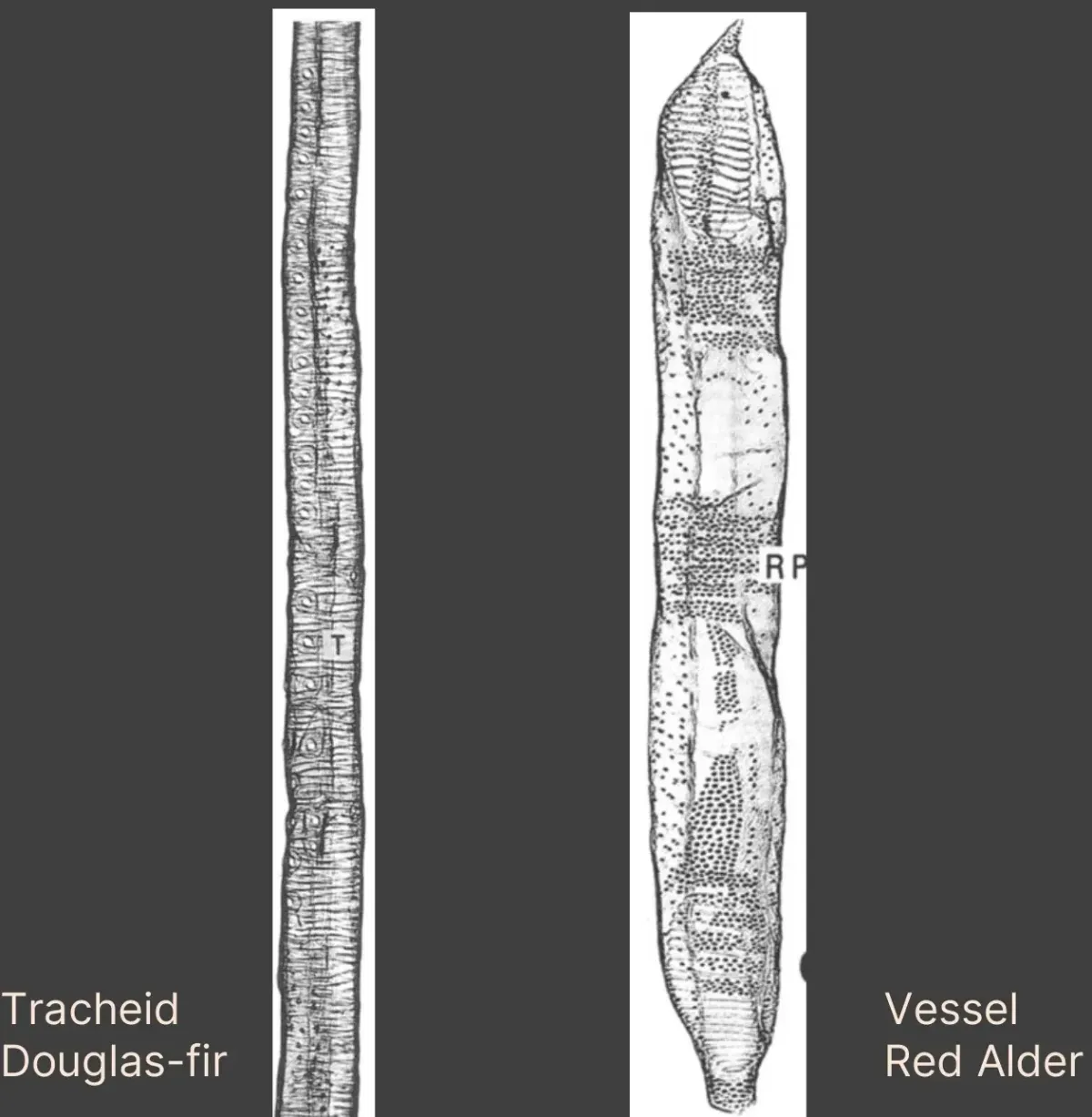
Both cell types are around 30 µm across — 0.00118 in, roughly a third the width of a human hair. Think of the xylem — the heartwood — as full of capillaries. That plumbing is why wood and water are inseparable, and the difference between a tracheid and a vessel is much of why species take preservative, stain and finish so differently.
2. Physical and mechanical properties
Wood's physical properties are the ones you can assess without breaking anything — four of them, and three are free:
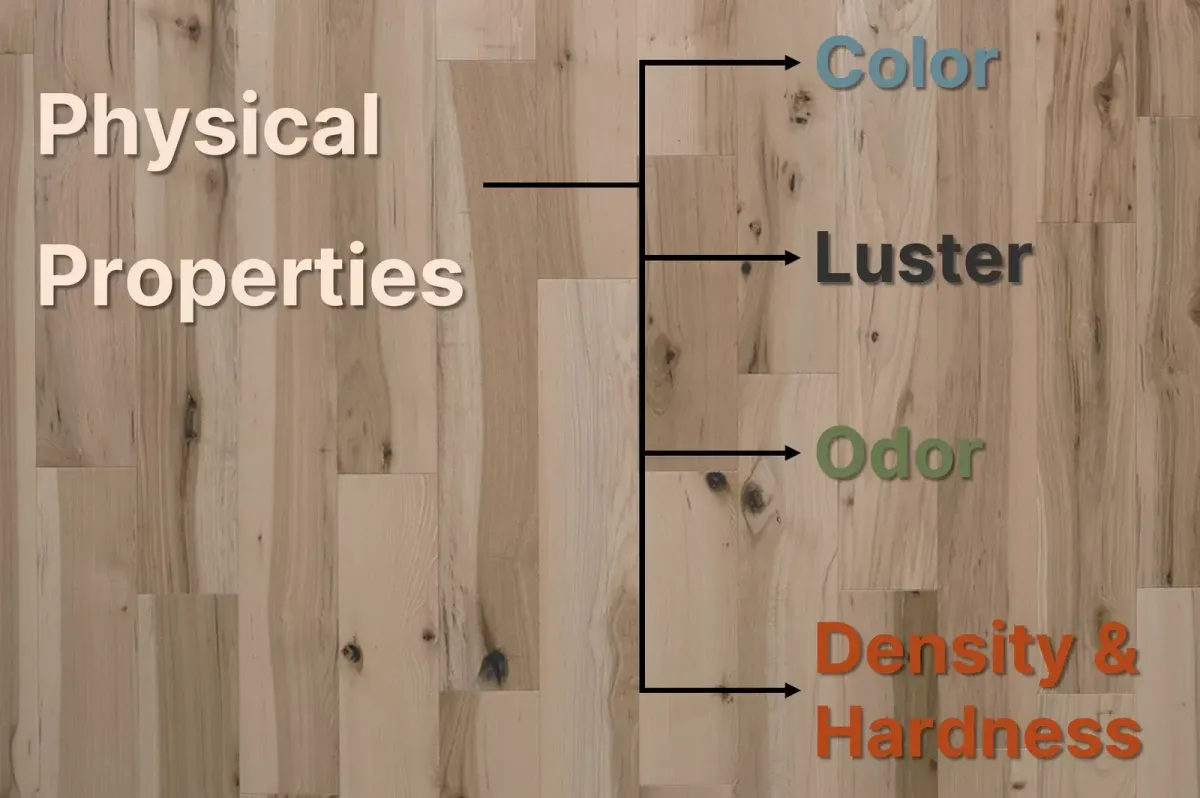
- Color. Largely a heartwood property, and largely extractives: the same compounds that make a species durable are often the ones that make it dark. Color is also the least permanent property on this list, because UV will change it.
- Luster. How the surface returns light. A function of cell structure and of the plane you cut — a quartersawn face is usually more lustrous than a flatsawn one.
- Odor. Also extractives, and a genuine identification tool: the smell of freshly cut western redcedar or teak is diagnostic. Odor and decay resistance often travel together.
- Density and hardness. The two that end up in the span table.
Density and specific gravity
Density is mass per unit volume, in kg/m³. Specific gravity is the ratio of a wood's density to the density of water, so it carries no units. Balsa sits near 0.15; western redcedar around 0.32; white oak around 0.68; lignum vitae above 1.2 — which is why it sinks.
Density is the single best predictor of the other properties. Denser wood is generally harder, stiffer and stronger. It is also heavier to handle and harder to fasten. Every one of the species we publish data for lists its density and Janka hardness for exactly this reason.
Strength and deformation
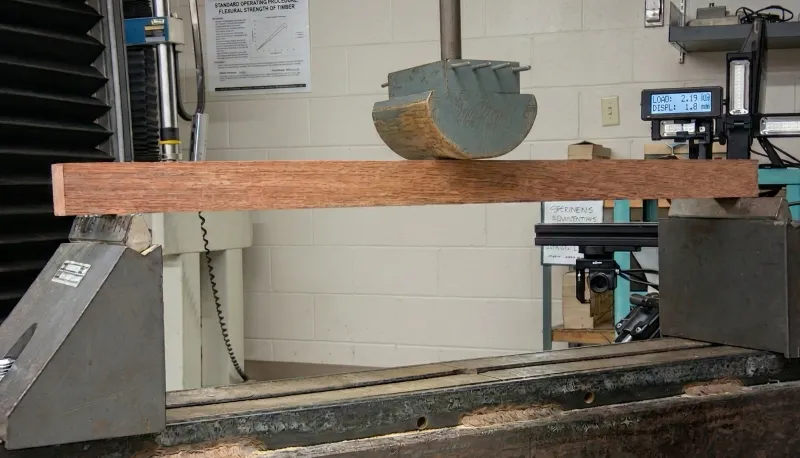
Mechanical properties are measured under ASTM D4761, the standard test methods for mechanical properties of lumber and wood-based structural materials. Three numbers do most of the work:
- Modulus of elasticity (MOE) — resistance to bending. Stiffness. How much a board deflects before it does anything dramatic.
- Modulus of rupture (MOR) — breaking strength. The stress at failure.
- Maximum load — the load the member carries before it breaks.
Those numbers are published species by species, and always at a stated moisture content, because the moisture content changes them. The USDA Forest Products Laboratory's Wood Handbook tabulates them for the commercially important American species: western redcedar tested green ruptures in bending at 35,900 kPa, while the same species at 12% moisture content ruptures at 51,700 kPa. A strength figure quoted without a moisture content is an incomplete figure.
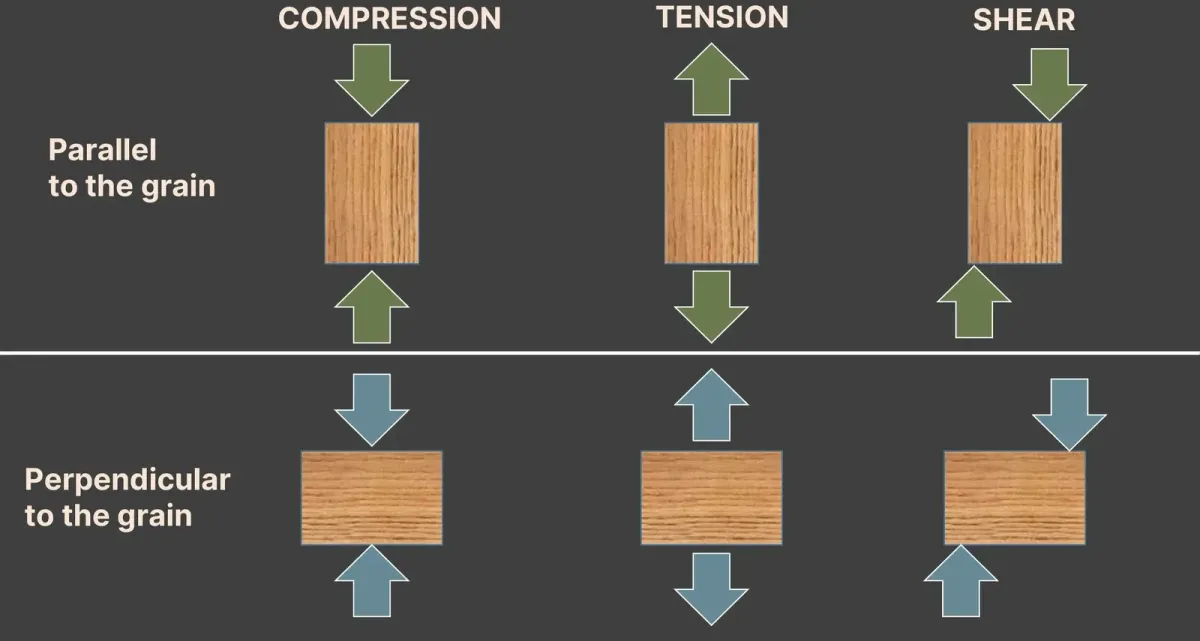
Wood is also loaded three ways — compression, tension and shear — and each behaves differently parallel to the grain than perpendicular to it. Wood is enormously strong in compression parallel to the grain (that is a post) and comparatively weak in compression perpendicular to it (that is a beam crushing into its bearing). Almost every connection detail in timber construction is an argument about grain direction.
3. Wood and water
If you remember one thing from this course, remember this: water and wood always interact. Always. There is no such thing as a wood product that has stopped exchanging moisture with its environment. Wood is hygroscopic — it takes on and gives off moisture in response to changes in relative humidity and temperature — and it is anisotropic, which means it does so unequally in different directions.
Moisture content, and how it is measured
Moisture content (MC) is the mass of water in the wood expressed as a percentage of the oven-dry wood:
MC = (mwet − mdry) / mdry × 100%
The oven-dry reference method (ASTM D4442) is 24 hours at 103 °C, about 217 °F. Weigh a sample wet, dry it, weigh it again. A board that weighs 6 lb wet and 5 lb after drying is carrying 1 lb of water on 5 lb of wood, so its MC is 20%. Note the denominator: MC is expressed against the dry wood, not the wet board, which is why MC values above 100% are perfectly possible in green timber.
On site you will use a meter, not an oven. Two kinds:
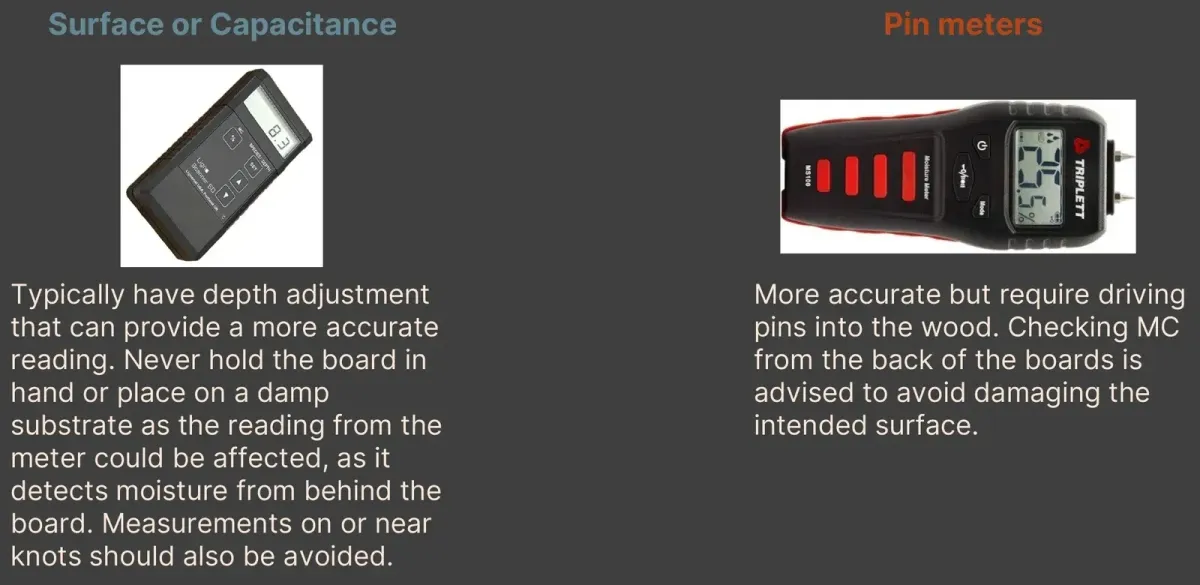
- Pin meters measure electrical resistance between two pins driven into the wood. More accurate, but they leave holes — so take readings from the back of the board, not the face you intend to show.
- Capacitance (pinless) meters read a field just below the surface. Non-destructive, usually with a depth setting. They are easy to fool: do not hold the board in your hand and do not lay it on a damp substrate, because the meter will happily read the moisture behind the board. Avoid knots.
Equilibrium moisture content — the number that actually governs your job
Relative humidity is the percentage of water vapor the air holds relative to the maximum it could hold at that temperature. Wood chases it. Left alone in stable conditions, wood arrives at its equilibrium moisture content (EMC) — defined by the USDA Forest Products Laboratory as the "moisture content at which wood is neither gaining nor losing moisture."
EMC is a function of relative humidity and temperature, and it varies enormously by geography and season. Relative humidity does nearly all of the work: plot EMC against both variables and the contours run close to vertical, so a change in humidity moves the number far more than a change in temperature does.
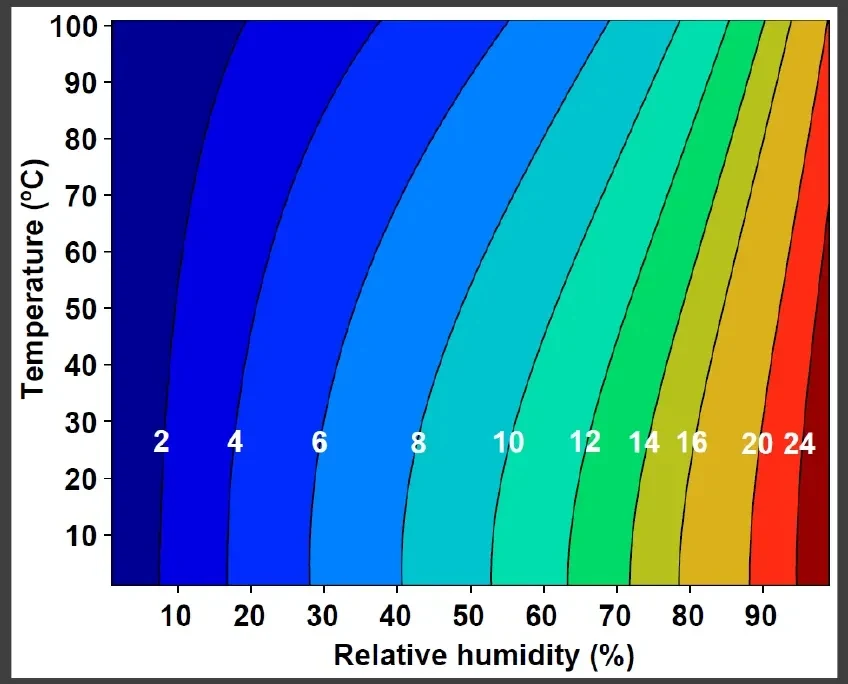
A few reference points at typical indoor and outdoor conditions:
| Relative humidity | EMC at 50 °F | EMC at 70 °F | EMC at 90 °F |
|---|---|---|---|
| 20% | 4.6% | 4.5% | 4.3% |
| 40% | 7.9% | 7.7% | 7.4% |
| 50% | 9.5% | 9.2% | 8.9% |
| 65% | 12.3% | 12.0% | 11.5% |
| 80% | 16.4% | 16.0% | 15.4% |
| 90% | 20.9% | 20.5% | 19.8% |
The practical consequence: wood installed at the wrong moisture content will move to the right one, and it will not ask permission. Honolulu's mean EMC runs roughly 10.6–13.3% across the year; Phoenix swings down near 4.6% in May. The same board is a different board in those two cities. Acclimate material to the conditions it will live in, and detail for the movement that remains.
Bound water, free water, and the fiber saturation point
Water enters wood in two places, and only one of them matters dimensionally.
The cell wall is a laminate, and the layers are worth naming because modification and decay both act on specific ones. Adjacent cells are cemented together by the middle lamella. Inside that sits the thin primary wall, and inside that the secondary wall in three layers — S1, S2 and S3 — wrapped around the hollow lumen. Each layer is built from microfibrils, bundles of cellulose chains laid down at a different helical angle in each layer, which is what gives the wall its strength.
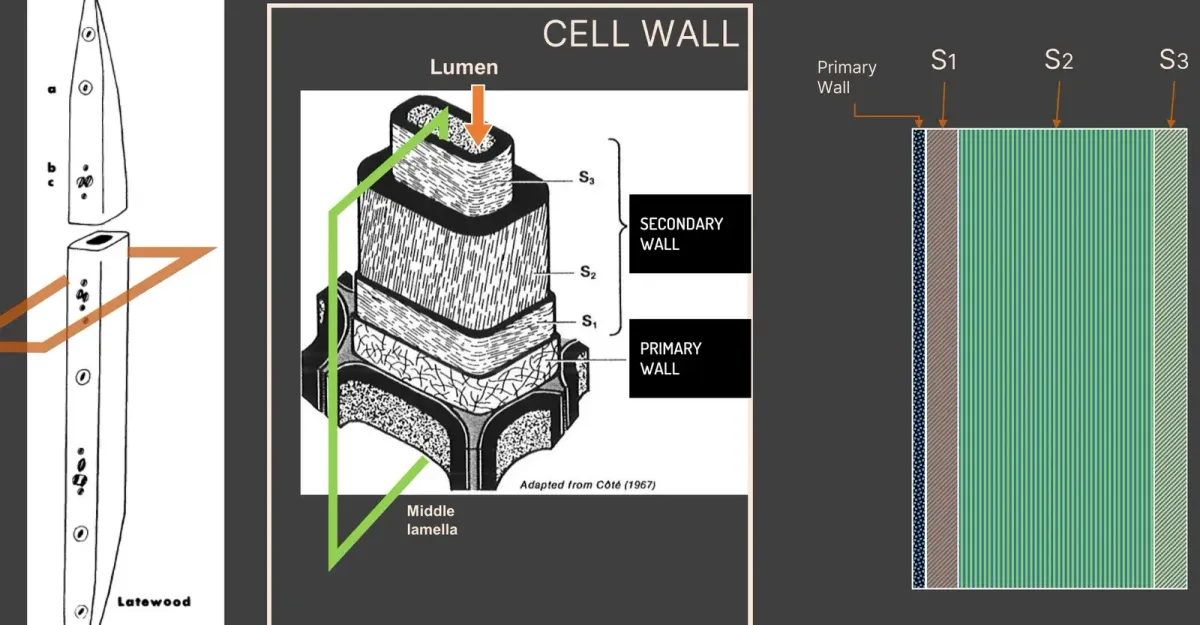
S2 is much the thickest layer, so it holds most of the wall's mass, most of its water, and most of its say in how far a board moves. Remember that: it is exactly the layer thermal modification goes after.
Cell walls are not uniform through the year either. The cells a tree lays down in spring — earlywood — are wide-lumened and thin-walled, built for conduction. The latewood laid down later in the season is narrower and much thicker-walled, built for strength. That alternation is what makes a growth ring visible in the first place, and the density difference between the two is why flatsawn softwood can raise grain when it weathers.
Chemically, the wall is roughly 45% cellulose, 25% lignin and 25% hemicellulose. Water molecules hydrogen-bond onto those polymers — this is bound water — and in doing so they physically push the chains apart. The wall gets thicker. The board gets bigger.
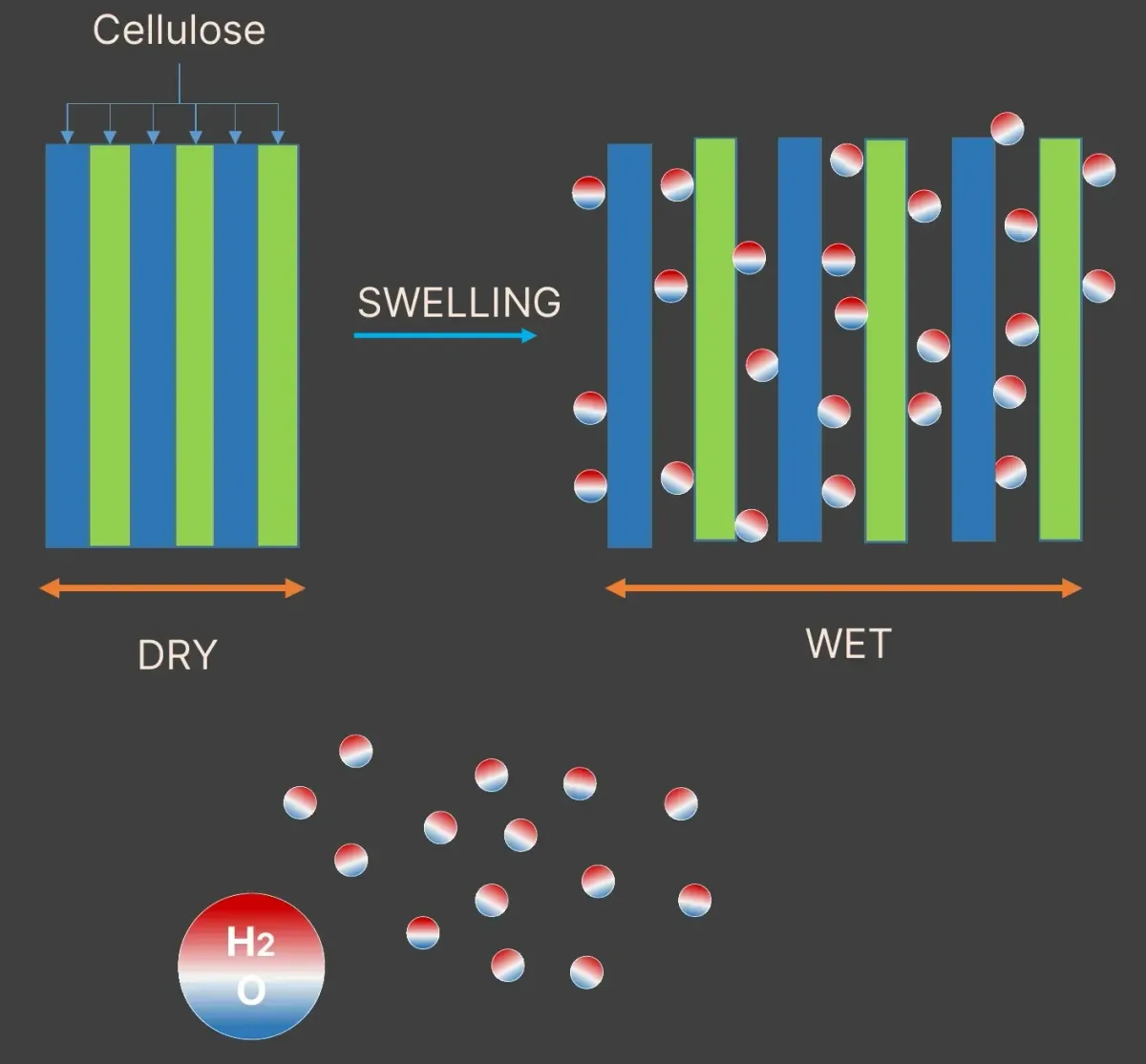
The three polymers are not equally thirsty, and the ranking matters more than the average. Measured by how much water each will hold, hemicellulose takes 25–35%, cellulose 10–20%, and lignin only 2–5%. Hemicellulose is the most hygroscopic component of wood by a wide margin — so the practical route to a stable board is to get at the hemicellulose, which is precisely what the modification processes in section 4 do.
Once the wall is saturated, no more water can bind. Any additional water simply pools in the hollow lumens as free water, and free water changes nothing dimensionally. The crossover — cell wall saturated, no free water present — is the fiber saturation point (FSP), at roughly 30% MC for most species.
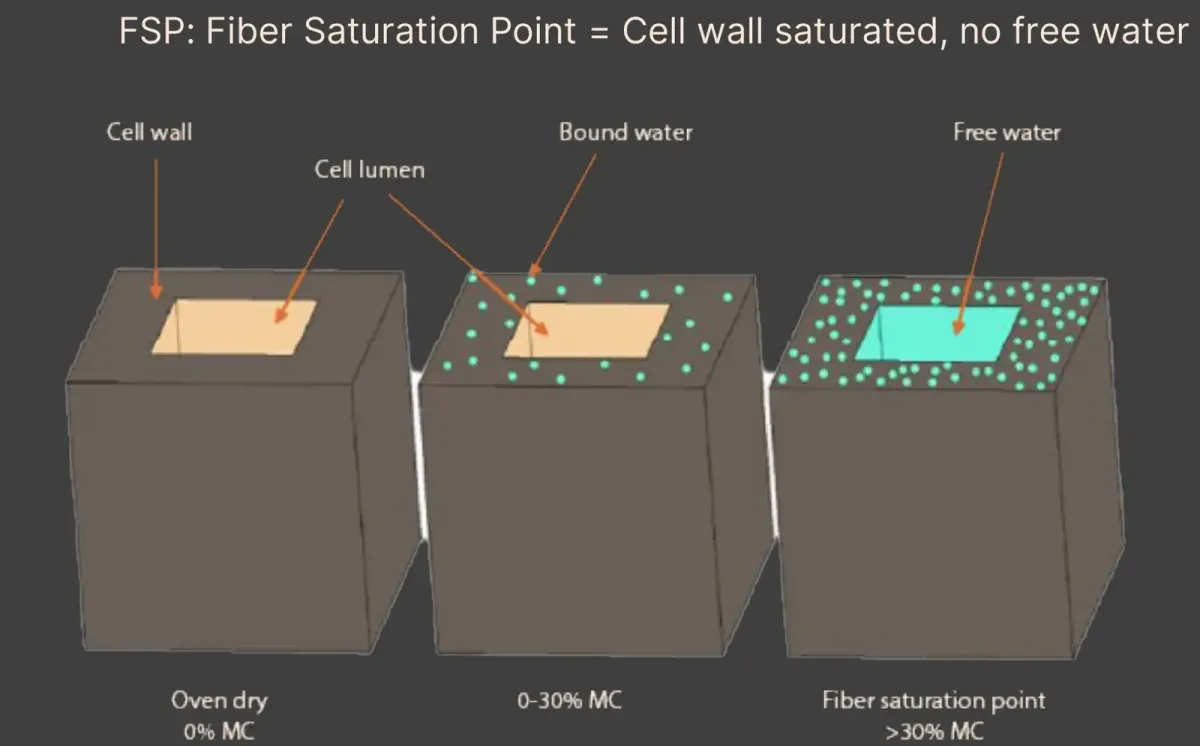
So: below 30% MC, wood shrinks and swells. Above 30% MC, it does not. Every dimensional problem you have ever had happened below the fiber saturation point.
Shrinkage, swelling, and why boards cup
Losing moisture is shrinkage. Gaining moisture is swelling. And because wood is anisotropic, the two do not happen evenly:
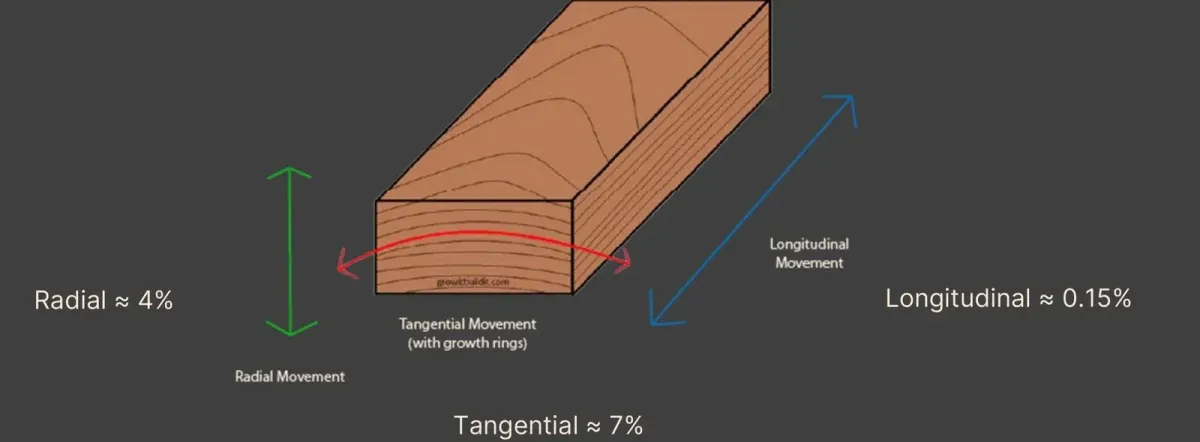
- Tangential ≈ 7% — with the growth rings
- Radial ≈ 4% — across the growth rings
- Longitudinal ≈ 0.15% — along the length
Tangential movement is nearly double radial movement. That single inequality explains cupping: a flat-sawn board's two faces sit at different distances from the pith, so they shrink by different amounts, and the board curls away from the bark side. It also explains why length is the one dimension you can design against — a 16-foot board does not meaningfully get shorter.
Repeated wetting and drying does the rest of the damage:
- Checking and splitting as the surface dries and shrinks faster than the core.
- Warping, cupping and twisting from uneven movement through the section.
- Fastener corrosion. Wet wood — especially treated wet wood — will oxidize a screw until there is nothing left of it but a rust stain in the shape of a screw. Use fasteners rated for the exposure and the chemistry.
- Composite failure. Wood-based composites exposed to sustained moisture swell, delaminate, crack, and eventually crumble.
- Biodegradation. Sustained moisture is the precondition for every fungus and most of the insects in section 5.
4. Modified wood
Modification attacks the problem at its source: if wood moves and decays because of what water does inside the cell wall, then change the cell wall.
Thermally modified wood
Wood is heated above 400 °F (204 °C) under controlled conditions in an atmosphere with essentially no oxygen, so it cooks rather than burns. The heat strips hydroxyl (oxygen–hydrogen) groups out of the S2 layer of the cell wall — precisely the sites that bind water below the fiber saturation point. Fewer binding sites, less bound water, less movement.
What you get:
- Permanently lowered EMC, and therefore markedly better dimensional stability.
- Increased resistance to rot and decay — the cell wall is a less appetizing meal.
- Lower density, around 30% on average post-modification.
- A rich, through-color that deepens with the intensity of the treatment (Thermo-S versus the more aggressive Thermo-D).
The numbers are not subtle. In a month-long submersion study — specimens held fully underwater, which is about as unfair a test as you can devise — flat-grain and vertical-grain Ambara (thermally modified ayous) 1×4 swelled less than 1%, while western redcedar swelled up to 4%. On a nominal 1×4 that is more than an eighth of an inch of movement in a material already considered stable.
Durability testing tells the same story. Under ASTM D1413 / AWPA E10 — the soil-block method, which exposes wood to pure cultures of decay fungi in moist soil — testing at Oregon State University's Wood Science & Engineering department found thermally modified ayous vastly outperformed western redcedar against Rhodonia placenta, Gloeophyllum trabeum and Pleurotus ostreatus. Cedar is genuinely durable. It was not close.
Acetylated wood
Sometimes called "pickled wood," for the acidic profile of the chemistry involved. Sustainably sourced sapwood is treated with a liquid acetic compound in a heated setting; the reaction converts the wood's free hydroxyl groups into acetyl groups. Same principle as thermal modification, reached chemically: the sites that would have bound water no longer can. The result is a stronger, markedly more durable timber. The best-known commercial product is a modified radiata pine, manufactured in Europe and the U.S. and widely available in North America.
Furfurylated wood
Furfurylation impregnates the wood with furfuryl alcohol — a compound derived from agricultural waste such as sugarcane bagasse and corn cobs — and then cures it so the alcohol polymerizes inside the cell wall. The wall ends up permanently bulked with an inert resin, which both blocks water and leaves nothing a fungus recognizes as food. It is a third route to the same destination as thermal modification and acetylation: fewer sites where water can bind.
Dually modified wood
Two steps, usually run continuously in a single pressure chamber:
- Thermal modification, as above.
- Full-cell pressure impregnation — a proprietary, nontoxic, high-melting hard synthetic wax is forced into the wood under pressure. It solidifies inside the cells, filling the voids. The infused compound has a melting point above 250 °F (121 °C), so it stays put in service.
You get the stabilized cell wall from step one and a physically blocked cell cavity from step two.
5. How wood deteriorates
Two categories: weathering, which is abiotic, and biodegradation, which is alive.
Weathering: UV and moisture
Ultraviolet radiation is the slow one. UV degrades lignin and other compounds at the surface, which is what turns exposed wood silver-grey and eventually leads to surface cracking. Most finishes are themselves unstable under UV, which is why "one and done" exterior coatings do not exist.
Moisture is the fast one. Successive wet and dry seasons drive successive swelling and shrinkage — a medium-to-short-term cycle that opens checks and splits, and every check is a door for fungi and insects.
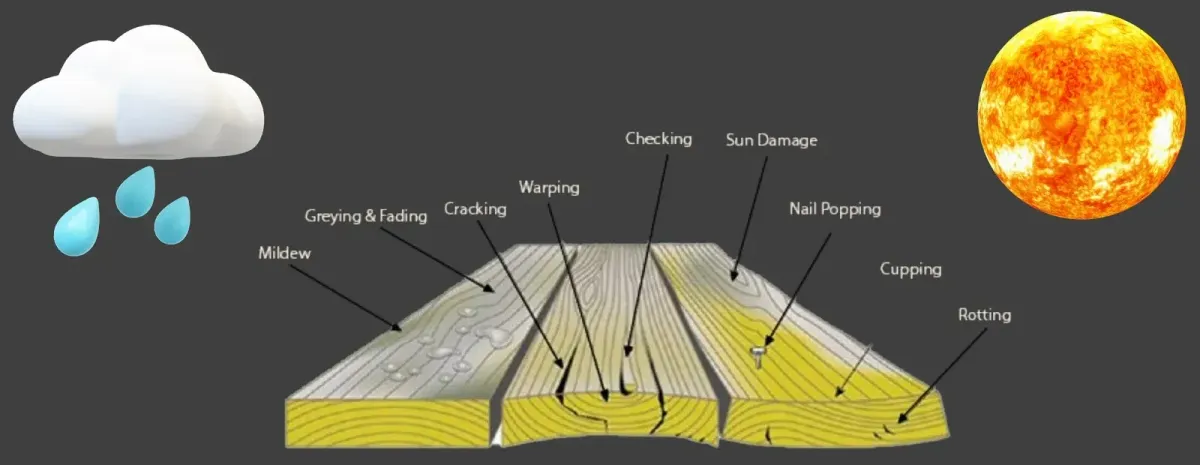
The visible vocabulary of a weathered deck — mildew, greying and fading, cracking, checking, warping, cupping, nail popping, sun damage, rotting — is just these two agents, working together.
Decay fungi
Fungi are heterotrophs: they cannot photosynthesize, so they eat. What they eat is your wood's carbohydrates. Their life cycle runs through spores, mycelium and fruiting bodies, and every one of them needs moisture to start. Four types matter:
- Molds. Superficial. They discolor the surface without meaningfully reducing strength — but some species are toxic to humans, so "it's only cosmetic" is not the whole story.
- Brown-rot fungi. They consume the carbohydrates first — cellulose and the rays — and do not degrade lignin. What is left is the brown, cross-checked, crumbling residue you can poke a screwdriver through. Common in softwoods.
- White-rot fungi. These degrade the whole lignocellulosic complex, lignin included. Strength is reduced significantly. Common in hardwoods.
- Staining fungi. Blue stain, zone lines and other pigments. The pigment penetrates the wood, so it cannot be sanded out, but strength loss is minimal to none. This is a grading and appearance problem, not a structural one.
Insects
Termites (Isoptera) come in three flavors, and the distinction determines your detailing:
- Subterranean termites nest in soil, require contact with the ground, and build the characteristic mud tubes to bridge from soil to wood. Break the ground contact and you break the infestation route.
- Dampwood termites want wet or green wood plus ground contact. Found in the Pacific Northwest, the Pacific Southwest and southern Florida.
- Drywood termites are the hard ones: they need no soil contact at all and will colonize very dry wood, below 13% MC. Prevalent in the Pacific Southwest, Hawaii included.
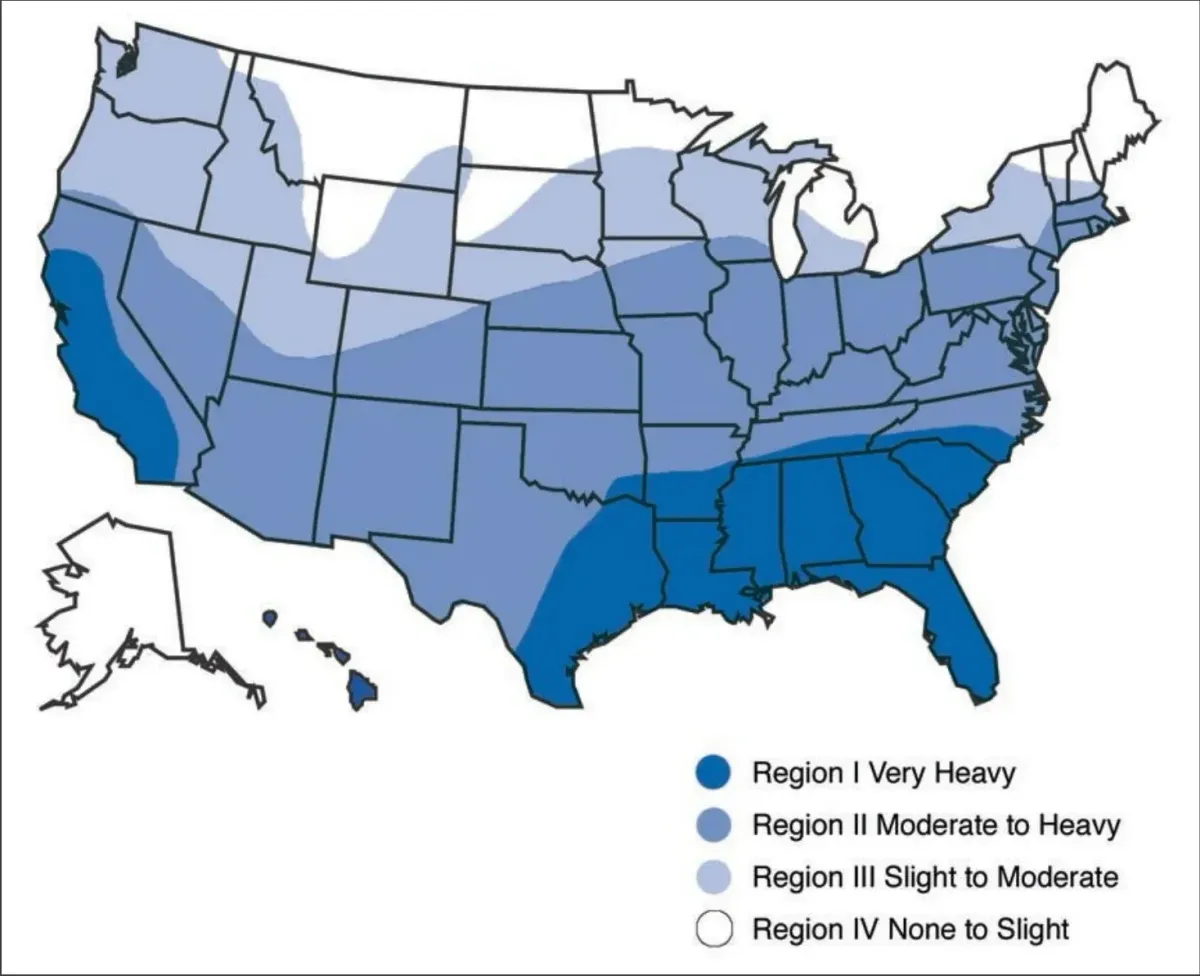
The USDA Forest Service's subterranean termite hazard map places Hawaii, the Gulf Coast, Florida, the southeastern seaboard and coastal California in Region I — "very heavy." If you build in those markets, termite resistance is not an upgrade, it is a baseline.
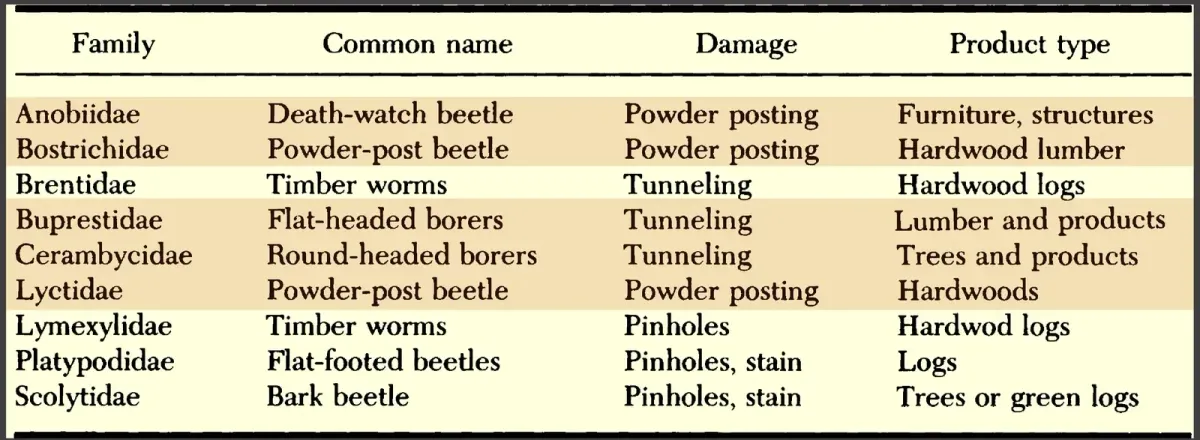
Beetles (Coleoptera) damage wood three ways. Pinhole borers live in symbiosis with wood-staining fungi (blue stain, ambrosia) and leave the pinholes they are named for. Powder-post beetles attack dry wood; their 1–10 mm larvae reduce it to a fine, flour-like powder. Tunneling beetles enter while the wood is green and their larvae bore galleries through it. Wasps, bees and carpenter ants round out the list — they do not eat wood, but they will excavate it to nest.
6. What this means when you specify wood
Pull the threads together and the practical rules are short:
- Design for movement, not against it. Wood below the fiber saturation point will shrink and swell — roughly 7% tangentially, 4% radially. Gap it, fasten it, and detail it accordingly.
- Get the moisture content right at install. Acclimate to the EMC of the actual location. A board installed at the wrong MC is a board that will move after you leave.
- Keep water moving. Ventilation, drainage, and no ground contact. Sustained moisture is the precondition for every fungus and most of the insects above.
- Match the material to the hazard. In a Region I termite market, or on a fully exposed south elevation, a naturally durable tropical hardwood or a modified wood is not a luxury.
- Fasten for the chemistry. The wrong screw in a wet, treated board will disappear.
Nova USA Wood Products supplies the naturally durable hardwoods and modified woods that this science points to. Compare the numbers yourself in our wood species guide, browse the product catalog, or pull the technical literature from our downloads library.
Questions about anything above? Email Micah directly at micah@novausawood.com. Mahalo nui loa.