
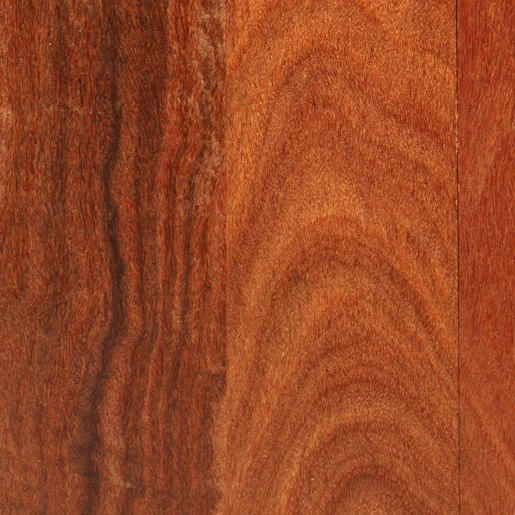
Cumaru Hardwood Technical Species Information
Detailed scientific and mechanical properties for Cumaru, Brazilian Teak Hardwood Lumber
Cumaru, Brazilian Teak
Cumaru, commonly called Brazilian Chestnut, is a tough and dense wood imported from Brazil that has an irregular, somewhat interlocked grain and wavy, course texture. Because of its density, it is very resistant to termites and decay. Cumaru's heartwood is a medium brown with distinctive tan shades that compliment one another in with tonal warmth to create a relaxing feeling that's great to come home to.
Cumaru, Brazilian Teak Wood Properties
- Janka Hardness
- 3,200 lbf
- Modulus of Rupture (MOR)
- 24,800 psi
- Modulus of Elasticity (MOE)
- 3,050 ×1000 psi
- Density
- 1,080 kg/m³
- Tangential Shrinkage
- 8.4%
- Radial Shrinkage
- 5.4%
- Botanical Family
- Leguminosae
- Tree
- The Cumaru tree can reach 160 feet in height with trunk diameters up just over 3 feet.
- Distribution
- Venezuela, Colombia, Brazil, Peru, Bolivia, The Guianas.
- Other Names
- Dipterix odorata, Southern Chestnut, Brazilian Teak
Cumaru, Brazilian Teak Characteristics
Color
Reddish-brown or purplish-brown when fresh, shifting to light-brown to yellowish-brown upon exposure. Sapwood is yellowish-brown.
Texture
Fine
Grain
Interlocked
Luster
Low to medium
Durability
Rated as very durable, resistant to brown and white-rot fungi, and has exemplary weathering characteristics.
Drying
Rated as easy to air season, can sometimes check and warp, uniformly rapid drying.
Workability
Rated as difficult to saw or bore. Poor for gluing due to high density and oily nature.
Applications
Cogs, flooring, decking, turnery, bearings, tool handles, railroad crossties, heavy construction.
Photosensitivity
Cumaru will darken upon exposure to light.
We specialize in both unfinished hardwood floors and prefinished flooring. Available width are 3", 4" and 5". Please see our product catalog for more information.
Cumaru, Brazilian Teak Products
View all in catalog →
Cumaru, Brazilian Teak
Cumaru, Brazilian Teak 1x4 MG First Clear S4S E4E KD

Cumaru, Brazilian Teak
Cumaru, Brazilian Teak 1x6 All Heart Std + Btr Rainscreen Siding

Cumaru, Brazilian Teak
Cumaru, Brazilian Teak 1x6 MG First Clear S4S E4E KD

Cumaru, Brazilian Teak