
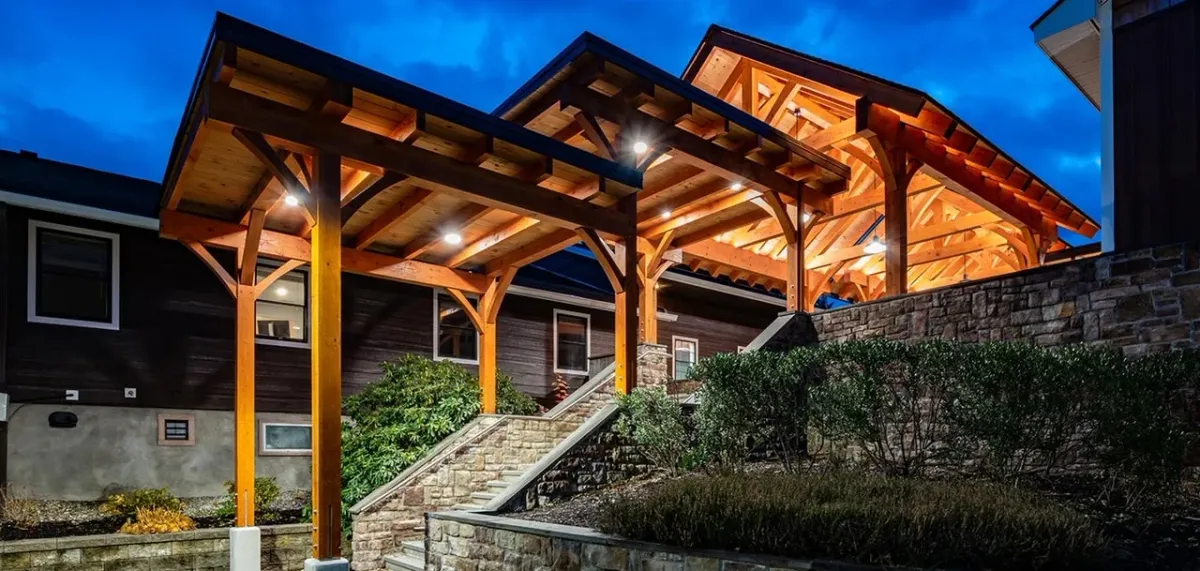
Douglas Fir Lumber Technical Species Information
Detailed scientific and mechanical properties for Douglas Fir Softwood Lumber
Douglas Fir
Douglas Fir Wood Properties
- Janka Hardness
- 710 lbf
- Modulus of Rupture (MOR)
- 12,400 psi
- Modulus of Elasticity (MOE)
- 1,950 ×1000 psi
- Density
- 530 kg/m³
- Tangential Shrinkage
- 7.6%
- Radial Shrinkage
- 4.8%
- Botanical Family
- Pinaceae
- Tree
- Tree can grow to a height 130 feet of with a diameter of up to 12 feet.
- Distribution
- Western US, Oregon, Washington, California; Western Canada, British Columbia
- Other Names
- Pseudotsuga menziesii, Blue Douglas-fir, British Columbia pine, British Colubian pine, Coast Douglas-fir, Colorado Douglas-fir, Colorado Pino real, Colorado real, Columbian Pine, Douglas spruce, Inland Douglas-fir, Interior Douglas-fir, Oregon Douglas-fir, Oregon pine, Puget Sound pine, Red fir, Rocky Mountain Douglas-fir, Yellow fir
Douglas Fir Characteristics
Color
Texture
Grain
Luster
Durability
Drying
Workability
Applications
Heavy timbers and post-and-beam framing, glulam beams and roof trusses, joists, rafters, studs and general house framing, sub-flooring and plywood, decking, flooring, siding, interior and exterior trim, doors and windows, joinery, millwork and stair parts, furniture, decorative veneers, tanks and vats, bridge and trestle timbers, wharf construction, marine pilings, utility poles, mining timbers, and scaffold plank.
A little history: Douglas Fir made its name at sea. British trader John Meares was shipping Northwest fir spars to China by 1788, and through the 1800s the tall, straight, knot-free sticks coming off Puget Sound became the mast of choice for the world’s sailing fleets — demand strong enough to spawn its own class of vessel, the lumber schooner, which was largely built of fir itself. When “Old Ironsides” — the USS Constitution — was rebuilt starting in 1927, no white pine long enough for her masts could be found, so the Navy stepped Pacific Northwest Douglas Fir instead. She is still a commissioned warship today.
Closer to home: the first softwood plywood ever pressed was three plies of Douglas Fir, made in 1905 at St. Johns, Oregon for an exhibit at Portland’s Lewis & Clark Exposition — about 25 miles from our Forest Grove yard. That exhibit started an industry. One more for the job site: Douglas Fir is not actually a fir. Its botanical name, Pseudotsuga, means “false hemlock,” which is why foresters insist on the hyphen in Douglas-fir. It is Oregon’s state tree, the country’s leading source of structural lumber, and roughly half of America’s Christmas trees.
Photosensitivity
Douglas Fir Products


Douglas Fir 1x4 VGX Clear S4S E4E KD

Douglas Fir 1x6 VGX Clear S4S E4E KD

Douglas Fir 5/4x4 VGX Clear S4S E4E KD


Douglas Fir 5/4x6 VGX Clear S4S E4E KD

Douglas Fir 4/4x6 VG 85/15 DENSE RGH KD
Douglas Fir 4/4x8 VG 85/15 DENSE RGH KD

Douglas Fir 4/4x10 VG 85/15 DENSE RGH KD

Douglas Fir 4/4x12 VG 85/15 DENSE RGH KD


