
Thermally Modified Woods - How are they different?
This article highlights the key differences between thermally modified wood and regular kiln dried wood
Steve Getsiv · September 26, 2026
Micah Sutfin · February 28, 2026
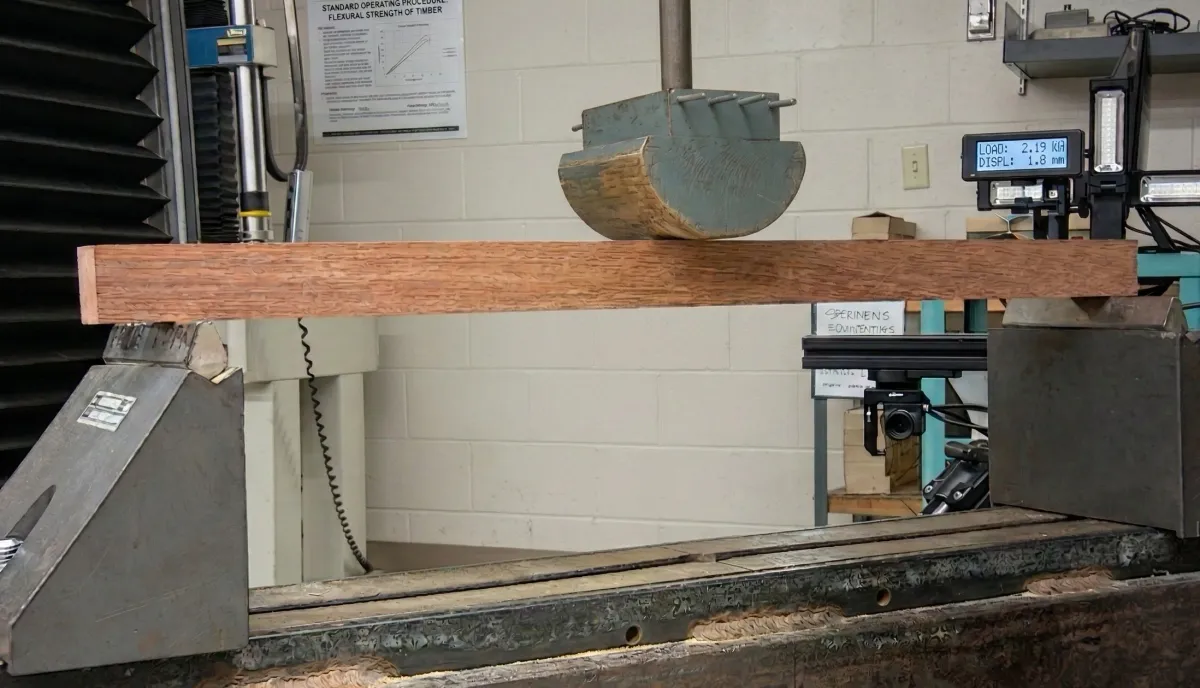
As the industry continues to navigate the supply chain challenges and reduced availability of Ipe due to its recent listing under CITES Appendix II, finding reliable, high-performance alternatives has become critical. To address this shortage, we initiated a comprehensive comparative study evaluating several other tropical hardwoods against Ipe. Our primary objective was to demonstrate that readily available species—specifically Torem, Bangkirai, and Batu—are statistically equivalent substitutes for structural and decking applications. By subjecting these materials to rigorous physical testing, we aim to show that these alternatives not only provide the strength and durability expected of Ipe but also offer more predictable and consistent material properties.
We have concluded our material testing on four tropical hardwood species: Torem (Manilkara kanosiensis), Bangkirai (Shorea laevis), Batu (Shorea guiso), and Ipe (Handroanthus spp.). The materials were systematically evaluated for the following key properties:
To ensure an accurate and equitable comparison, all boards were stacked and stickered in an environmental conditioning chamber maintained at 20°C and 65% relative humidity (RH) until they reached equilibrium prior to testing.
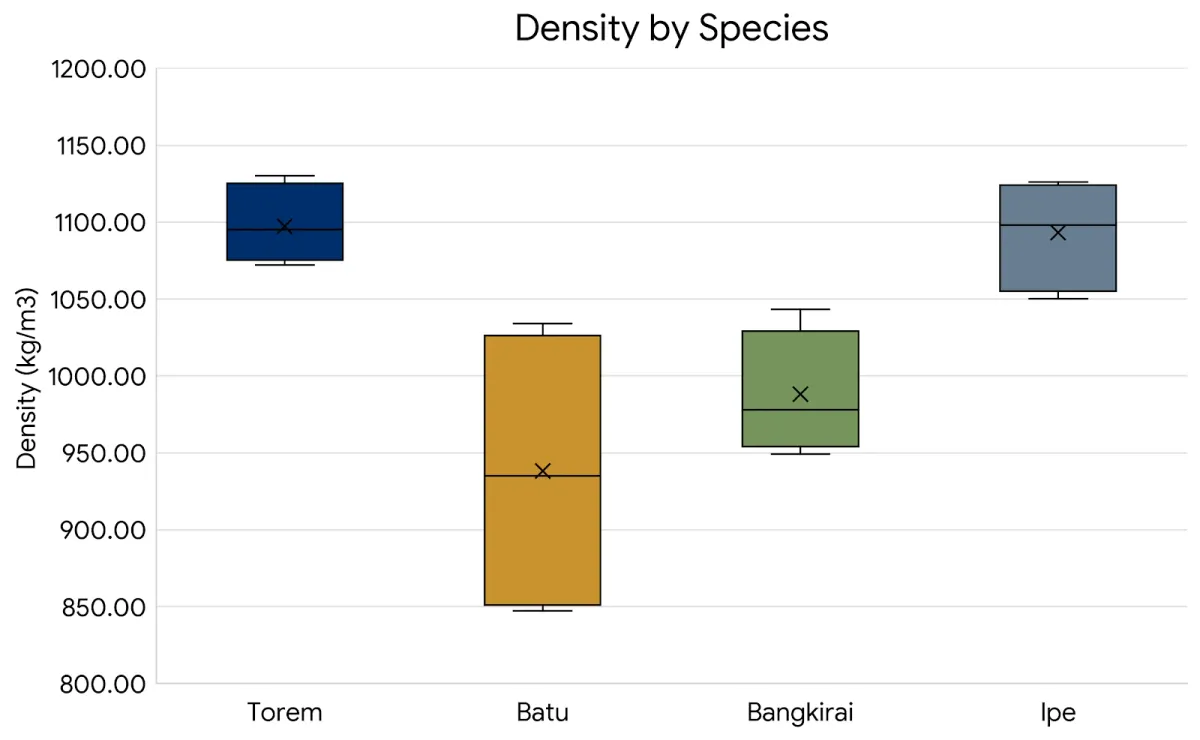
The average density and moisture content for the specimens at the time of the test are documented below.
Density Summary:
Moisture Content Summary:
| SPECIES | MOISTURE CONTENT (%) | STD. DEV. |
|---|---|---|
| TOREM | 14.8 | 0.1 |
| BATU | 13.5 | 0.6 |
| BANGKIRAI | 15.6 | 0.6 |
| IPE | 12.4 | 0.5 |
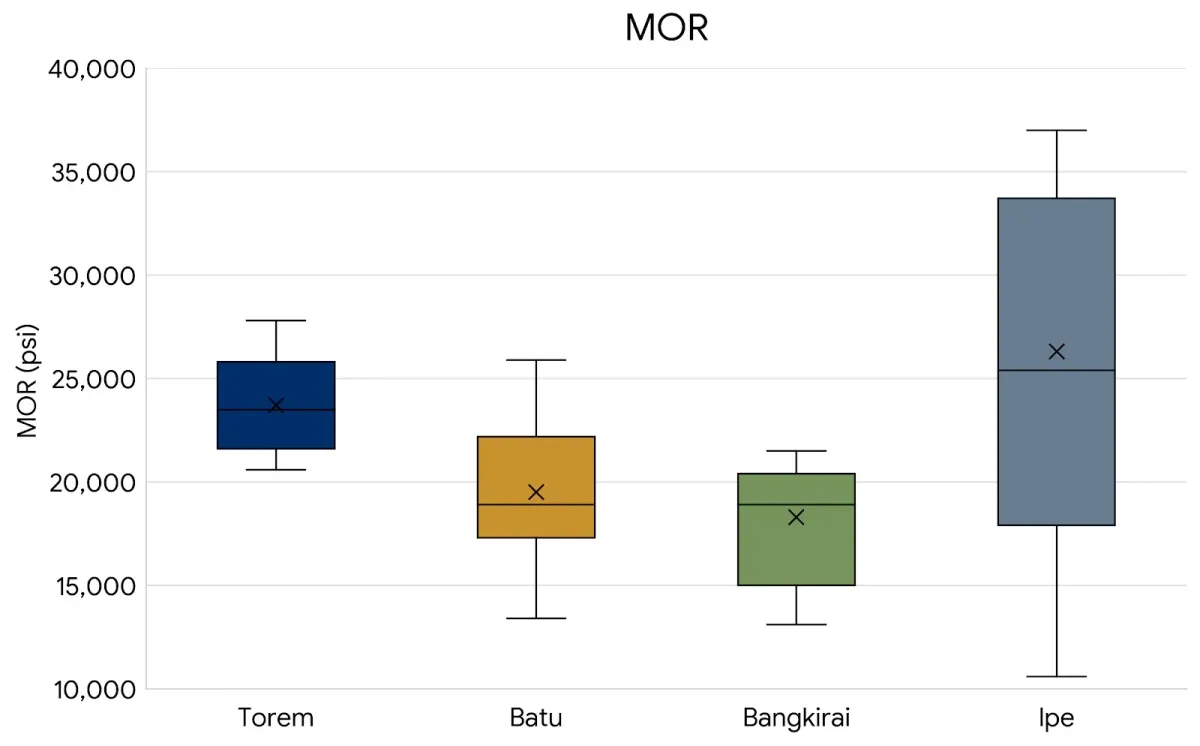
The table and plot below outlines the average and standard deviation for the bending strength (MOR) of each species.
| SPECIES | AVG.MOR (psi) | STD. DEV. |
|---|---|---|
| TOREM | 23712 | 2250 |
| BATU | 19518 | 3313 |
| BANGKIRAI | 18328 | 2639 |
| IPE | 2633 | 7917 |
The table and plot below illustrates the average and standard deviation for bending stiffness (MOE).
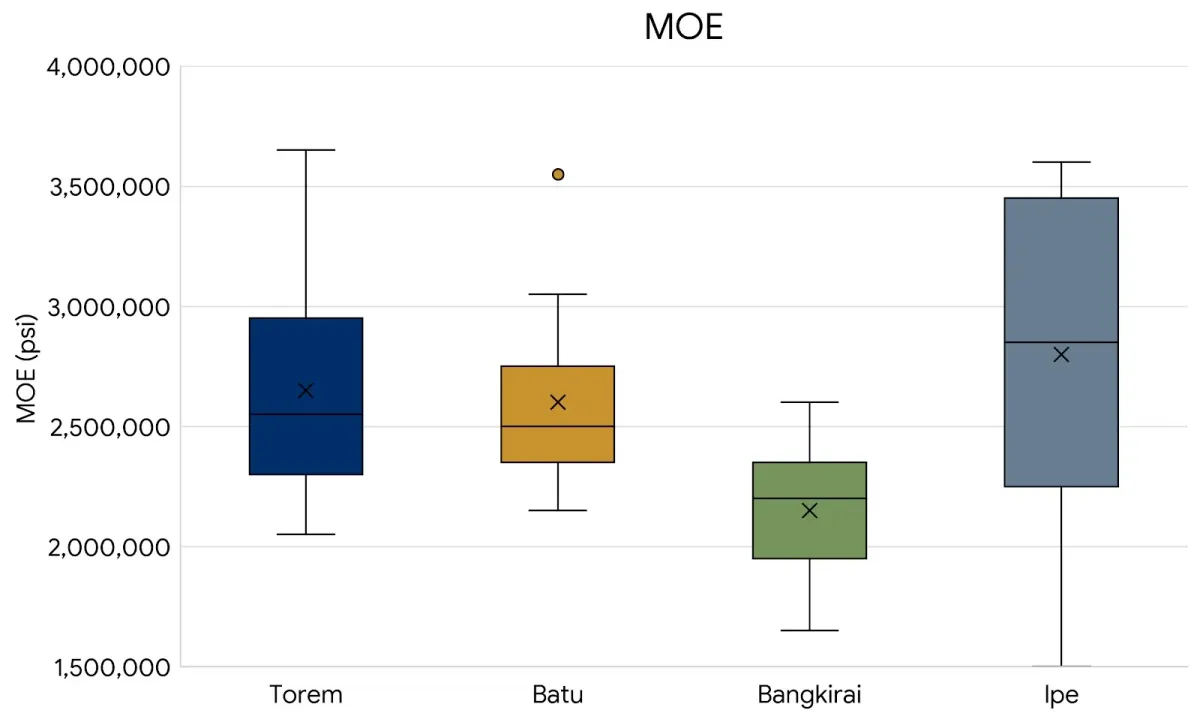
| SPECIES | AVG.MOE (X10^6 psi) | STD. DEV. |
|---|---|---|
| TOREM | 2.65 | 0.458 |
| BATU | 2.62 | 0.344 |
| BANGKIRAI | 2.16 | 0.260 |
| IPE | 2.82 | 0.647 |
Key Observation on Bending Variability: While Ipe yielded the highest average values for both MOR and MOE, the variability within the Ipe samples was significantly higher than the alternatives. Specifically, the standard deviation for Ipe's MOR was 2.4 to 3.5 times higher than the other species. Similarly, Ipe’s MOE values varied 1.4 to 2.5 times more than the comparison group.
The table below details the average and standard deviation for the hardness of each species.
| SPECIES | AVG.HARDNESS (lbs.) | STD. DEV. |
|---|---|---|
| TOREM | 3257 | 502 |
| BATU | 1878 | 392 |
| BANGKIRAI | 2084 | 450 |
| IPE | 3715 | 667 |
Key Observation on Hardness: Consistent with the bending test results, Ipe exhibited the highest average hardness. However, it once again displayed the widest margin of inconsistency, with hardness values varying 1.3 to 2 times more than the other tested species.
The data clearly demonstrates that we have highly viable, statistically equivalent alternatives to Ipe. It is important to emphasize that while Ipe is historically recognized for its high density and peak strength, our testing reveals that its performance values are remarkably inconsistent compared to other tropical hardwoods.
Torem, in particular, emerges as an exceptional substitute. It compares very closely to Ipe in overall physical performance but delivers significantly tighter standard deviations. This means Torem offers structural predictability and consistency that Ipe currently lacks, making it a highly reliable choice for future projects while bypassing CITES-related supply chain hurdles.
This article highlights the key differences between thermally modified wood and regular kiln dried wood
Steve Getsiv · September 26, 2026
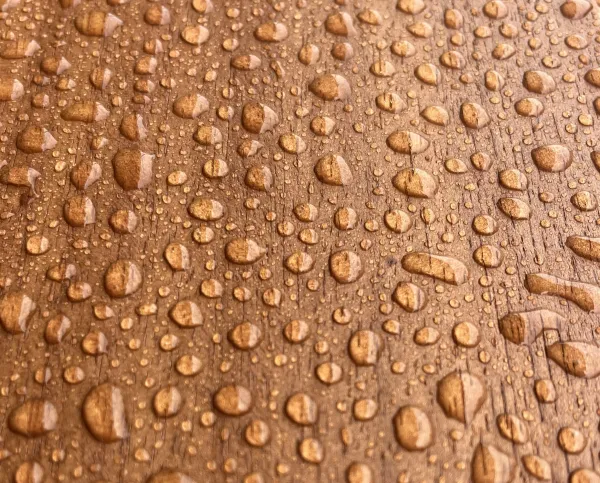
This articles discusses moisture management in trailer floors and how to protect them from failure. NovaSeal is Nova's new water-based industrial floor sealer.
Micah Sutfin · October 24, 2025
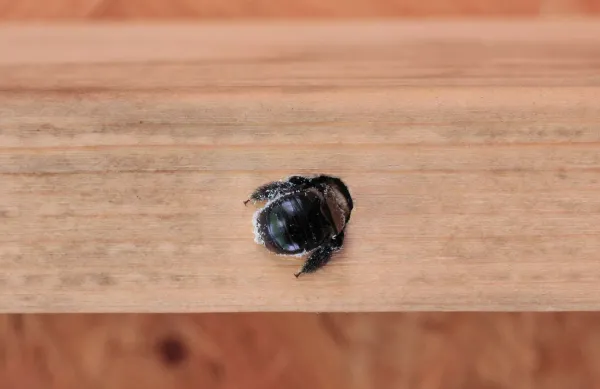
This article discusses the durability of thermally modified wood including methods of treating termite damage, wood peckers, and carpenter bees.
Micah Sutfin · August 27, 2025